

AeroRevenue
Know every airport charge is right before you invoice.
Are the cross winds of Month end slowing you down?
AeroRevenue replaces disconnected spreadsheets and databases with one controlled billing workflow.
If your current billing process is harder to trust than it should be,
Like landing fee billing that still depends on an old database, several spreadsheets or manual month-end checks, a short demonstration will show you exactly where AeroRevenue can fix your pain.
We'll walk through the process from importing movements through to reviewing exceptions, generating invoices and producing reports.
A practical demonstration tailored to your airport.
No obligation.
WHEN THE OLD PROCESS STILL WORKS
The real risk isn't that your spreadsheet stops working.
It's that nobody notices when something is wrong.
Legacy billing processes can keep running for years. That's often why replacing them gets pushed down the list.
But the problems heap up.
A registration doesn't match. A movement is missed. A tariff changes but an old calculation remains somewhere in the process. A manual edit isn't documented. An invoice needs to be checked six months later and the person who understands the spreadsheet isn't available.
AeroRevenue gives your airport a more controlled process without asking staff to give up the operational knowledge they've built over the years.
With AeroRevenue:
- Unknown aircraft are flagged for review rather than slipping through and billed incorrectly
- Invoice-ready data can be exported for the accounting system
- Changes and user actions can be traced through the audit log
- Source movements remain connected to the resulting charges
- Tariffs are configured centrally rather than buried in spreadsheet formulas
- Waived and exempt movements retain a reason
BUILT FOR NEW ZEALAND REGIONAL AIRPORTS
Airport billing software without the enterprise-system overhead.
AeroRevenue does one job: landing fee and passenger movement billing for New Zealand regional airports. There’s no enterprise rollout and no custom development.
Built for the way regional airports actually bill.
Mixed Traffic, one runway
Scheduled services, general aviation, training, charter and medical flights share the same runway, but they aren’t all billed the same way.
Movements that shouldn’t be billed
Medical flights, waivers and concessions need careful handling, not a number quietly edited in a spreadsheet.
Registrations that need matching
A landing arrives with a registration. Someone still has to confirm the aircraft, the owner and the MCTOW before it can be charged.
Passenger data from a separate source
Passenger charges come from different data than landings, but they still have to come together at month-end.
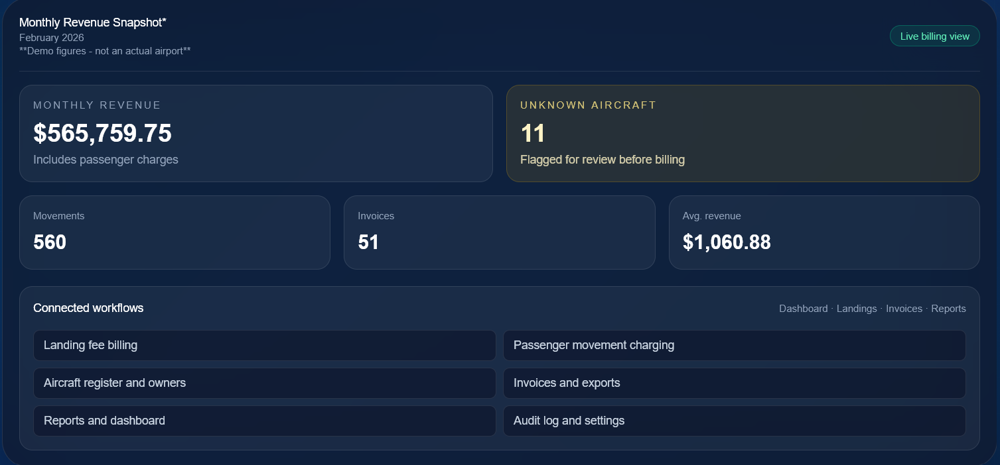
Demo figures – not an actual airport
Here’s how AeroRevenue handles each of those
One billing workflow from movement data to invoice.
Landing data
Import monthly landing movements and match registrations against the aircraft register and owner records.
Monthly invoicing
Create the billing run, review invoices by period and export invoice data for your accounting package.
apply your airport's rules consistently
Calculate charges from aircraft weight, tariff settings and applicable exemptions while keeping exceptions visible for review.
See exactly what was billed
Review revenue, movement volumes, aircraft activity and other billing information without rebuilding reports from spreadsheets.
Passenger movements
Keep the movement data, billing calculations, invoices and audit history connected, so there is a clear path from the source data to the final charge.
Trace every change
Maintain a record of system activity and billing changes so questions can be investigated later.
A MORE CONTROLLED BILLING PROCESS
Less manual handling. Better visibility. A clearer audit trail.
- Catch exceptions before billing; Unknown aircraft, unmatched registrations and waived movements are made visible for review rather than disappearing inside a spreadsheet or manual process.
- Apply your billing rules consistently: Landing fee brackets, passenger tariffs, exemptions and airport-specific rules are applied through the system rather than being recreated manually each month.
- See how the numbers were produced; Keep the movement data, billing calculations, invoices and audit history connected, so there is a clear path from the source data to the final charge.
Unknown aircraft, unmatched registrations and waived movements are made visible for review rather than disappearing inside a spreadsheet or manual process.
Frequently Asked Questions
Questions airport teams usually ask us
No. AeroRevenue handles the specialist airport billing work that happens before the transaction reaches your accounting package.
It calculates the applicable charges, creates the billing records and produces invoice data that can be exported for systems such as Xero. Your accounting package remains your financial system of record.
Yes. AeroRevenue can import landing movement data, aircraft register information, aircraft owner details and regional passenger movement data.
For New Zealand airports, this can include Airways landing data, CAA aircraft information and Air New Zealand regional passenger movement files, depending on the airport's existing process.
Implementation would take about 8 hours.
AeroRevenue has been noted to be exceptionally user friendly. Two hours training proved to be enough.
Unknown or unmatched registrations are flagged for review before billing. Once the correct aircraft or mapping has been established, the movement can be resolved using the appropriate aircraft and billing information.
That is an important part of the system: exceptions should be visible.
Yes.
Landing fee brackets, passenger tariffs and relevant exemptions are configured for the airport. AeroRevenue is intended to apply your billing rules consistently, rather than force your airport into a generic tariff structure.
Yes. AeroRevenue keeps the underlying movement and billing information available so staff can review what was charged and why.
The audit log also provides a record of relevant system activity and changes.
Yes. AeroRevenue keeps the underlying movement and billing information available so staff can review what was charged and why.
The audit log also provides a record of relevant system activity and changes.
Book an AeroRevenue Demo
Tell us a little about your airport and your current billing process.
We'll tailor the demonstration around the parts that matter to you.
See AeroRevenue using a workflow relevant to your airport.
No obligation.
See AeroRevenue using a workflow relevant to your airport.
No obligation.
Contact Us - hello@aerorevenue.nz
Level 1, Devon Center, 44 Liardet St
New Plymouth, New Zealand
© AeroRevenue 2026
All Rights Reserved